Industry Challenge: Selecting the Right Sweater Material Without Compromising Brand Integrity
Fashion brand owners and apparel buyers frequently face a foundational procurement dilemma: choosing between cotton and polyester for Men Sweater development - especially when launching seasonal collections for Autumn/Winter. Over-reliance on cotton can lead to inconsistent shrinkage, higher care requirements, and limited shape retention across bulk production. Conversely, pure polyester may raise concerns about breathability and perceived quality among premium boutique labels. The real challenge isn't which fiber is 'better' - it's aligning material performance with your brand's operational reality: target customer expectations, retail channel requirements (e.g., department stores demanding low-maintenance SKUs), e-commerce return rates tied to fit consistency, and private label timelines.


Understanding the Product Category: Men Sweater as a Strategic Retail Asset
In global apparel sourcing, Men Sweater is not just a category - it's a high-velocity, margin-sensitive vehicle for brand expression and seasonal storytelling. For Fashion Brands, it anchors capsule collections; for Retail Apparel and Department Stores, it delivers dependable replenishment volume; for E-commerce Brands, it supports fast-turnaround campaigns with consistent sizing and wash durability. Boutique Fashion Labels use it to convey curated aesthetics - like color blocking - without sacrificing wearability. And for Private Label Collections, the Men Sweater category offers scalable differentiation through fit, pattern, and fabric engineering - all anchored in reliable manufacturing execution.
Key Customization Options for Men's Color Block Cardigan Sweater
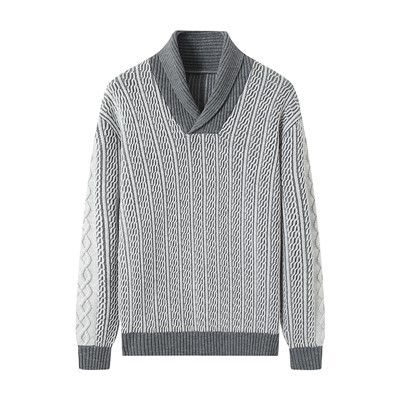
The Men's Color Block Cardigan Sweater exemplifies how material and structure serve strategic positioning:
Material Options: Polyester Blend Knit offers balanced performance - tensile strength for repeated wear, dimensional stability after laundering, and compatibility with vibrant color-blocking without bleeding or fading.
Knitting Techniques: Fully fashioned knit construction supports clean seam lines and consistent drape - critical for button-front symmetry and color-block alignment across sizes.
Sizes: Regular Fit accommodates broad demographic ranges while maintaining shelf appeal across Retail Apparel and Private Label Programs.
Labels & Packaging: Custom woven neck labels, heat-transfer tags, and branded polybags are integrated into standard OEM workflows - no minimums beyond base order quantities.
Private Label Services: Full-service support includes tech pack review, Pantone-matched dye lots, and hangtag design coordination - aligned with brand guidelines for Fashion Brands and E-commerce Brands.
OEM and Private Label Manufacturing Process
A repeatable, transparent workflow ensures predictability for buyers:
Design Review: Technical feedback provided within 3 business days - focusing on construct feasibility, stitch density, and color separation for Color Block patterns.
Sampling: First prototype delivered in 10–12 days; revision rounds capped at two unless structural changes are requested.
Material Confirmation: Physical swatch books with lot-specific test reports (including pilling and stretch recovery) shared prior to bulk approval.
Production: Lead time begins upon confirmed PO and deposit; production tracking updated weekly with photo documentation of key milestones.
Quality Inspection: In-line checks at 30%, 60%, and 90% completion; final AQL 2.5 inspection conducted pre-packaging.
Packaging: Standard carton configuration optimized for LCL/FCL efficiency; custom packaging available without tooling fees for orders ≥1,000 units.
How to Choose a Reliable Manufacturer
When evaluating a knit sweater manufacturer, prioritize decision criteria that directly impact your bottom line and brand promise:
MOQ: Confirm whether quoted MOQs apply per style or per colorway - especially relevant for Color Block Design, where multiple fabric components increase setup complexity.
Lead Time: Ask for documented cycle times - not just averages - including sampling, bulk production, and post-production QC windows.
Quality Control: Verify if inspections cover dimensional accuracy (critical for Regular Fit consistency) and colorfastness across wash cycles - not just visual defect counts.
Communication: Assess responsiveness during initial inquiry; time-zone-aligned contact points reduce iteration delays for Private Label Collections.
Customization Capability: Ensure technical capacity for custom cardigan sweater features - like button placement tolerance, placket reinforcement, and multi-panel color registration - before committing.
Supply Chain Stability: Review raw material sourcing transparency - particularly for polyester sweater production - to anticipate dye-lot continuity across reorder seasons.
This structured approach transforms supplier selection from subjective preference to objective procurement logic - especially when comparing cotton sweater versus polyester sweater options for commercial viability.
Recommended Products
The Men's Color Block Cardigan Sweater is purpose-built for brands requiring seasonal versatility and operational reliability. Its Polyester Blend Knit delivers consistent hand-feel and recovery across size runs - supporting Fashion Brands launching cohesive Autumn/Winter narratives and Retail Collections needing uniform SKU performance. The Button Front Cardigan silhouette and Color Block Pattern offer instant visual distinction, while Regular Fit ensures cross-channel wearability - from boutique fitting rooms to e-commerce try-on confidence. As a private label knitwear solution, it reduces development risk without limiting brand voice.
FAQ
Q: Which is better for sweaters, cotton or polyester?
A: Cotton offers natural softness and breathability, while polyester provides better durability, wrinkle resistance, and shape retention. The right choice depends on your target market and product positioning.
Q: Why do many fashion brands choose polyester sweaters?
A: Polyester sweaters are durable, easy to care for, resistant to wrinkles, and suitable for large-scale production, making them a popular option for commercial apparel collections.
Q: Can cotton and polyester be blended in knitwear?
A: Yes. Cotton-polyester blends combine the comfort of natural fibers with the durability and stability of synthetic fibers, making them ideal for many fashion brands.
Q: How do I choose the right sweater material for my fashion brand?
A: Consider your target customer, seasonal requirements, desired fabric performance, care instructions, production budget, and brand positioning before selecting sweater materials.
Conclusion
Selecting the right material and partner for Men Sweater development goes beyond fiber specs - it's about matching your brand's growth stage, channel strategy, and operational discipline with a manufacturer's proven execution. Whether you're scaling a private label knitwear program or refining a custom sweater manufacturer relationship, clarity on customization scope, process transparency, and material rationale builds long-term sourcing resilience. Request Samples to validate fabric performance firsthand. Discuss Your Project to align technical parameters with your collection calendar. Or Learn More About Manufacturing Options tailored to your brand's scale and ambition.