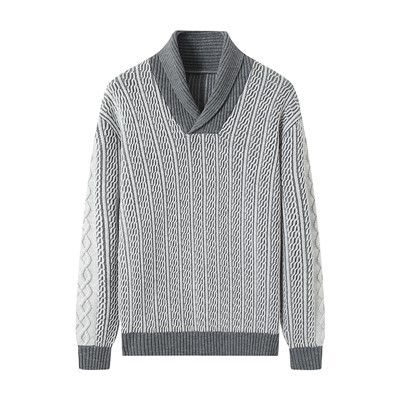
Knitting
A sweater consists of a body, back, and two sleeves. A pullover has four pieces, and a cardigan has five. Knitting refers to the process of weaving these pieces onto a machine. Knitting is generally divided into hand-knitted pieces and machine-knitted pieces (computerized flat knitting machines). Hand-knitted pieces are made by hand-knitting wool fabric into a sweater. Any pattern can be knitted without needing to be sewn on a sewing machine, as the entire sweater, including the collar, chest patch, and pockets, can be knitted.
Cutting
This refers to cutting the knitted pieces into the required shapes according to the pattern. Most machine-knitted pieces require cutting, while most sweater cutting is done by hand. Solid-color fabrics knitted on a circular knitting machine can be cut with electric shears. Hand-knitted fabrics rarely require cutting, except for specific styles.
Boning
Purpose: To prevent the cut edges of the knitted pieces from unraveling. There are three-thread and four-thread boning options. Types include:
1. Single-layer boning;
2. Double-layer boning.
Single-layer boning (commonly known as "running piece") is then followed by sewing on a sewing machine. Double-layer stitching involves stitching two layers of fabric together, without needing to be sewn together with a sewing machine. For mobile phone knitted pieces, only the yarn edges need to be stitched, including the sleeve top and shoulder edges.
A sewing machine refers to a type of sewing equipment. Its main function is to sew together garment pieces (including the front, back, sleeves, collar, chest, pockets, and other accessories).
Basic methods
1. Edge trimming: Sew the straight seams of the closed edge together.
2. Buttonhole stitching: Button or sew the horizontal seams of the open edge together.
Types
Seamstress, Button, and Seamstress.
Handling/Removing stitches
Hand stitching combined with machine stitching for areas that cannot be sewn together. Three aspects:
1. Yarn removal and edge trimming;
2. Handling;
3. Buttoning.
Washing
Washing plays a very important role in the sweater manufacturing process because the feel of the sweater is largely controlled by the washing process.
Purpose
1. Stain removal
2. Hand feel control
3. Softness/stiffness control of the sweater
4. Shaping (shrinkage control)
Ironing
Ironing sweaters differs significantly from other garment manufacturing processes because sweaters shrink after washing and require ironing to reshape and fix the size. Ironing sweaters requires a steam iron and a special ironing board. Procedure: Prepare two wooden ironing boards for ironing sleeves and body → Steam iron sleeves → Steam iron body
Labeling
This refers to sewing the customer's requested labels (main label, care label, size, etc.) onto the sweater. A. Bridge Label – Sew the label onto the garment from both sides.
B. Hanging Label or Tag Label – Sew the top of the label onto the garment.
Inspecting the Garment
① First Light Inspection
② Second Light Inspection
③ Inspect the Garment
Mending
When there are defects in the knitting of the garment, such as loose stitches, torn holes, misaligned stitches, or other defects, they can be repaired using knitting needles or hand stitches. Even damage caused by unraveling of sewing machines, such as loose stitches, skipped stitches, or snags, can be repaired using mending.
① Repair Washing Damage
② Repair Packaging
Packaging
Folding → Packaging → Boxing